The king of the sea might be you!
A bit like all the simulators that can exist, Seafarer: The Ship Sim gives you the opportunity to create your own character. Via a very simplistic character editor and shallow on changes, it will only be possible to modify one’s ethnicity, gender and face. For the rest, you will then have to choose the look of your protagonist in terms of clothing, and you are ready to work as a coast guard or for a logistics company, Crescenport Logistics. The whole thing is meager in terms of customization.
Moreover, after a long tutorial to familiarize yourself with the various controls of your first ship, you will be asked to make your choice between the two options that we mentioned above. This will obviously have little impact on the rest of the game, other than having a choice on your first starting ship. Of course, the other boats will be purchasable much later via a tablet interface which we will discuss later.
Once past all this, you are immersed in a decent-sized map. Certainly, the title is still in early access so obviously, the size of the map and the activities to do should, we hope, diversify. The software allows in this current version to ride freely on the map and carry out some secondary missions with the two factions, or to focus on the first two narrative chapters of the software.
Incidentally, we remain very doubtful about the narrative aspect of this simulation. With your character, you follow Teddy, who asks you to help him work for Crescenport Logistics, this famous logistics company under the leadership of a new CEO, Ruben Brooks. Obviously, tensions rise between Teddy and Ruben when a lot of little mishaps occur during simple routine missions. There are a few elements in the narrative that can be exciting, but at the moment it’s hard to get anything done with it. Indeed, the characters remain very hollow, lack life in the cutscenes, while offering very weak staging.
The routine of a coast guard or a logistician
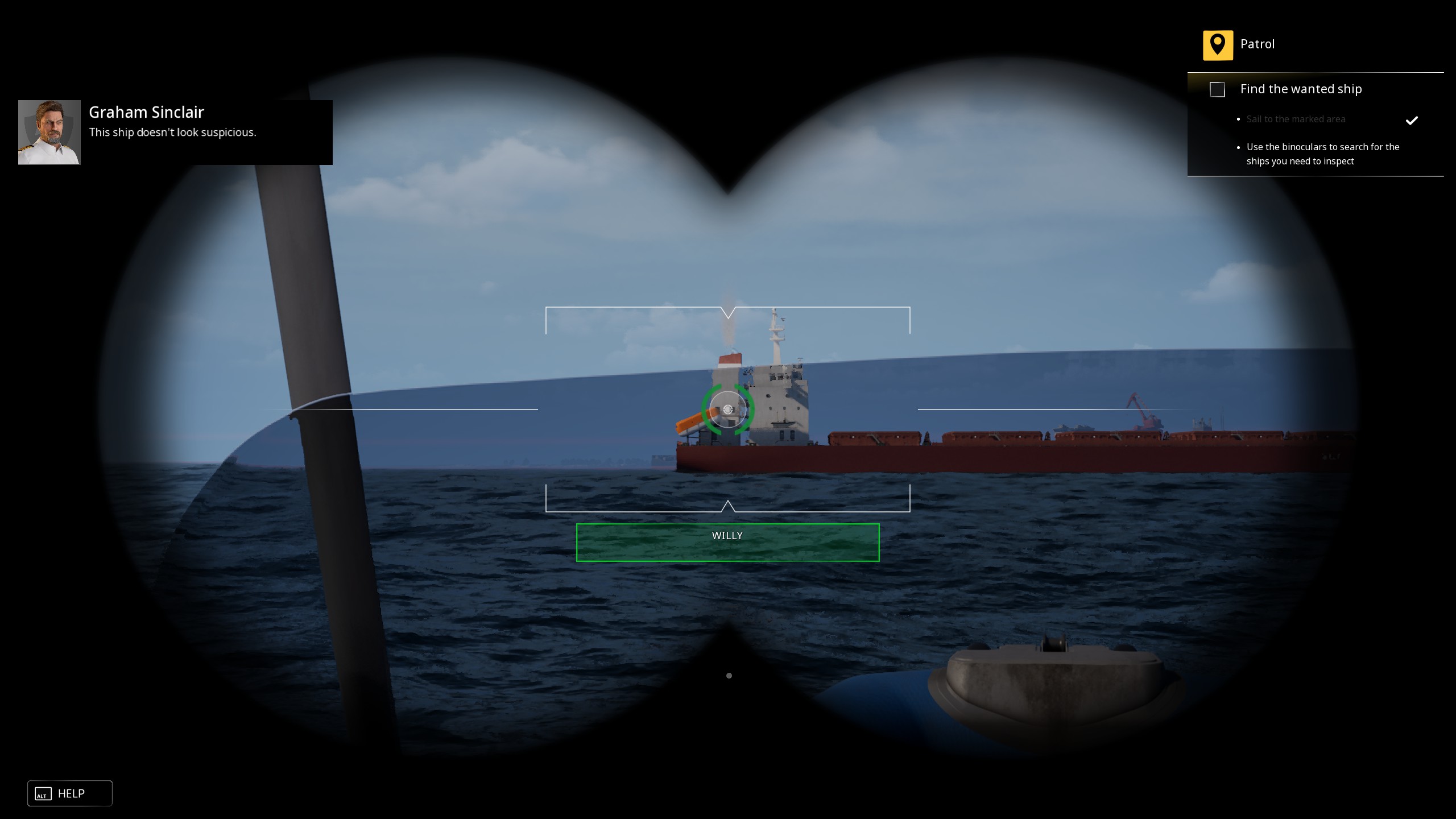
But in short, apart from these blemishes, know that the title offers an open and truly transcendent maritime playground at first. You can really go wherever you want on the map (provided you don’t exceed the limits), discover new ports, other unknown places, but also make sure to manage the engine, fuel or even hull gauge.
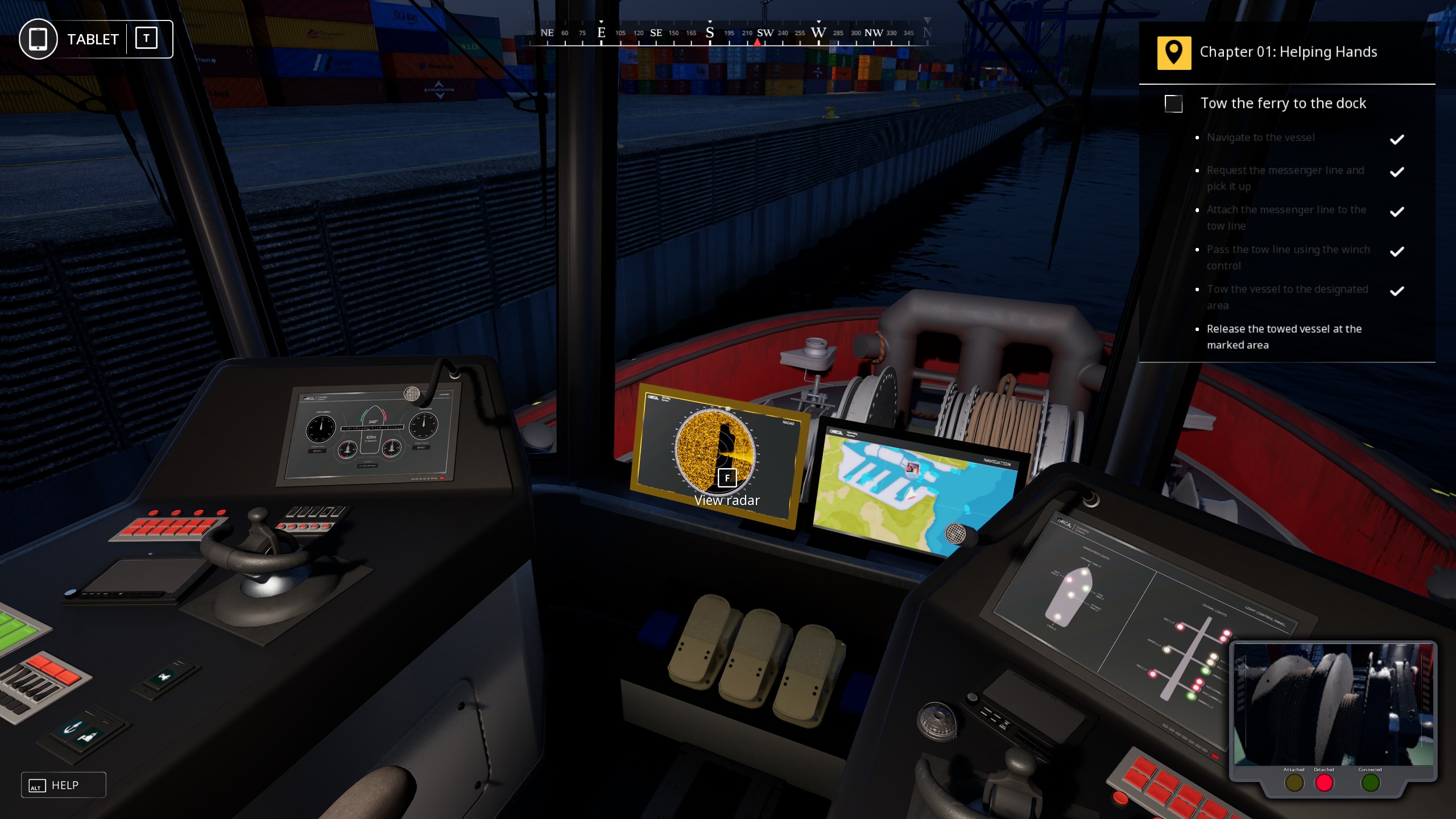
This is where we immediately recognize the simulation aspect of the game, and know that you can repair or refill the gauges only if you arrive at the various ports. Moreover, driving will vary relatively depending on the boats. You will go from an easily handled inflatable coast guard boat to a medium-sized ship or a huge cargo ship. Each of these cars will have their own specificity in driving, and you will be able to manipulate them by switching from third person to subjective view with a simple touch.
It must be admitted, the driving is indeed simulated by the slow driving of our barges. Special mention to the wind speed which must also be taken into account, thus forcing you to better negotiate your turns, or to concentrate when it comes to parking your boat next to another. In fact, on some coast guard missions, you will have to park next to another boat, and approach it to inspect it, in order to check that everything is in order with the equipment and captain.
Although there are qualities in the simulation aspect, we find ourselves faced with a classic progression, but not too surprising. By roaming the map or completing missions, you gain experience which increases your rank. In fact, each rank unlocks a new level for each element of various boats which you will then have to buy with your money, and thus improve it.
It’s very generic, especially since the game quickly goes in circles on its gameplay loop. Expect to do some hefty coast guard missions where you’ll have to spot certain boats, board them, check that everything is in order, and so on. Funny at first, these missions are repeated tirelessly to the point of nausea. The same goes for logistics missions where you must bring goods on board a cargo ship or, conversely, load and unload large containers using a huge crane that you will pilot yourself.
Everything quickly becomes very painful, and even the elements to be discovered are ultimately only very artificial. Fortunately, and in addition to the scripted missions which try to bring a little diversity, you have the opportunity to make rapid trips to go from point A to point B. Via the game map, you can draw your route, and make your car move more quickly. Plus, interestingly, fuel is necessarily factored into the equation.
Only here, we don’t have the impression that the fuel is really emptying, even if you don’t completely arrive at your destination, the latter still moving forward… Apparently, by wanting to try a lot of elements to make the title an ultimate maritime simulation, Astragon has not made the necessary efforts to correct certain bugs, which can therefore harm the experience.
It remains to be seen if the developer can rectify the situation on all elements of the game between now and its release in early access. This probably seems to be the case since obviously the studio and publisher plans to add new missions for each faction, new boats and even multiplayer missions. Unfortunately, the set will not arrive until early 2026, hoping that this is not too late to fill the void and the repetitiveness of the missions.
An immersive, but simplistic interface for simulation…
Nothing is great about this early access, but some bright ideas come from the tablet interface. Here, you can re-customize your protagonist or accept missions or not, but also hire crew members. For a tidy sum of money, you can assign officers or engineers, who will help you better manage your ship if you have a few hull problems or broken engines.
Very nice on paper, we still have difficulty seeing the beneficial effect of this mechanic on the gameplay. Another thing that is very under-exploited overall like the overall gameplay, which even incorporates a few pseudo mini-games that are not very stimulating to fill a few tanks on the engines for example. Even the system of borrowing and debt to be repaid is ultimately anecdotal, and has little influence on gameplay for the moment. Especially since generally speaking, you have plenty of time to repay the debt within seven days without being worried.
The boats to be purchased will also have a tab. They are worth a lot, and unfortunately encourage you to do the horrible missions which are repeated over and over again. Furthermore, note that you can also, on the fleets tab, improve the various elements of the ship (radars, map, etc.) or repair the engine or hull when you arrive in a port. Once again, the good will of the developer and publisher is there, but the lack of resources and ideas is felt on the game system. We will note only six ships available at launch, with others approaching, but as we mentioned above, this will not be before 2026…
What’s more, the graphic aspect of the title was clearly made with a jigsaw. Capable of displaying very pretty lighting effects and offering very beautiful water and ship models, the rest is hideous. Whether it’s the additional settings representing the mainland or the 3D models, nothing is going well. There is work that seems neat on the interface and the immersion of the cockpits of each ship, but overall, the game is passable at best, ugly at worst.
The bugs are also legion with textures running or disappearing, and here we have a title which, in addition to having optimization that is sometimes cut short, fails to really shine. We won’t talk about the soundtrack, epic certainly, but laughable like the dubbing, where each protagonist speaks with a sealed mouth.
We come away more than mixed from this experience on Seafarer: The Ship Sim. In addition to being ultra-bugged and having terrible progression that doesn’t really make you want to go further, Astragon’s maritime simulation doesn’t score many points on its launch in early access. If the narrative missions are intriguing and driving the boats remains exhilarating, we must admit that this will certainly not be enough to hook the player at the time of writing these lines. Because with repetitive content and not being able to renew the missions given on each port, it is difficult to see how the software can raise its head currently. We will see how the game evolves in its early access, especially as big content arrives in 2026 with new missions and a multiplayer mode. We have hope because some good gameplay ideas are there. But everything is either under-exploited, or nipped in the bud by other artificial mechanics which do not make you want to put your heart and soul into this title. Let’s wait until 2026 to see if the additions will alleviate this mixed impression.