Note: The publisher has teamed up with Ironwood Software and Popppy Works for Slave Zero X: Episode Enyo, a mod for Quake featuring Shou, the protagonist of Slave Zero
There Will Be Blood
Released in April 2024, Slave Zero presents itself as a concentrate of the 90s, at the same time as a prequel to the episode released in 1999. We find a common atmosphere there, among other affiliations, notably narrative. However, in terms of video game experience the two titles differ completely. If the first one was a third-person mecha game, SZX is a pure beat’em all, but we’ll talk about it in more detail a little later. First of all, let’s talk about the universe of the work, this industrial and technological world, where the depths evoke a feeling of oppression and permanent confinement. We travel through sinister environments. Hope no longer even seems to exist on the surface. The sun’s rays no longer have space to slip in and warm tormented souls.
To break the general torpor, the light comes only from the neon lights of commercial and advertising signs which sometimes invade the frame, or via the sheaves of blood from all these decimated bodies on our path. We are sowing death in this cold city dotted with cables and pipes that could resemble a living organism. There are even terrifying faces that adorn certain building facades, seemingly watching us or vomiting on us. They want us to believe, like the manga Blame! (all things considered, of course), that the city is an entity in its own right. A being who crushes bodies. We feel it, and that’s good, it was one of the objectives of the Poppy Works teams. It was the opportunity for them, the teams, to further explore the Biopunk aspect of the first game that the publisher at the time preferred to smooth out.
The artistic direction of the title serves a narrative context, sets an atmosphere, and shows the tiny cogs of an authoritarian and sick society. Prequel obliges, narrative elements echo the first Slave Zero, situations are now being answered. Developed on RPG Maker, the game is raw, in the most literal sense of the word. Raw like the omnipresent gray of its settings, like this city consumed by chaos, frozen in an atmosphere of the end of the world which perfectly fit the decade artistically summoned (not that of the game which takes place in a more distant future). By favoring PS1-style polygonal 3D environments and 2D characters, a contrast is created which is not devoid of charm. This fully contributes to the atmosphere, in addition to connecting with the aesthetics of the previous title.
The soundtrack also plays a crucial role. She mixes styles with a clear desire to maintain a very 90’s soul. Techno sounds rub shoulders with electro, sometimes a certain mysticism too, recalling the perdition of humanity, the world in decline or even Japanese science fiction animation. Sometimes pieces impose an aggressive cacophony. Instruments jump with imperfections, emphasizing how broken this city and its inhabitants are. For what remains of the inhabitants… Despite the violence and the noisy aspect that several types of music can take on, others are intended to be calmer, more luminous, shall we say. We can read there a sign of hope, a gesture of beauty that exists in this darkness.
They Will Kill You
The desire to suffocate us is obvious. The police, the main enemies of the game, attack relentlessly, leaving us little respite. In the middle of the action, we only breathe through the perfect execution of a combo or the methodical extermination of a group of lobotomized clones. At the controls of Shou and his organic armor, soberly named X, we climb the layers of the city and its buildings. We trace a road of blood through an industrial hell. We sow chaos and violence, not without a certain style, until we overthrow the monstrous elites cloistered at the top. Where gold and lust adorn the corridors and rooms. Where light illuminates the quarters of a mad scientist’s palace. Where contempt and madness dominate.
The storyline is a real mess. It’s hard to keep up and, therefore, hard to stay engaged. Moreover when you have to stake your life on almost every confrontation. The staging does not help with immersion in the story either, only the dubbing achieves a conclusive result, infusing the right amount of character into the characters, particularly our protagonist. Then SZX is a bit talkative for not much. For us, narrative efforts overall don’t work. And it’s not just a matter of taste or receptivity, there are clumsinesses that are detrimental (dialogues superimposed on combat, blocks of text and excess information, forgettable staging, etc.). We’re not here for that, fortunately, even if, in fact, the developers aimed to involve us more with their story…
That being said, as mentioned earlier, Slave Zero ultimately tells more things through its settings, its artistic direction and its gameplay, than through words and overtly narrative sequences. Controller in hand, things happen and a story is written within ourselves. If the adventure can, on paper, be completed in less than two hours, you will first have to suffer to reestablish your own justice and thus hope to quickly reach the final boss. Which could take several hours depending on your talents. We go through the courses as quickly as possible because time seems to be running out. The enslavement is uncontrollable, the city and humanity are sick and we hope to have the strength to get back up despite the repeated failures often attributable to the approximations of game design.
Quote from Francine Bridge, artistic director on Slave Zero : (…) I think our metaphor was very direct: the City is literally a machine for generating suffering, reinforcing the power of a ruling class or a central figure. The network of pipes running through each level was our most frequent recurring motif; a pile of pipes evokes function, complexity and industrial detail, but also veins. The City is not a living being in the literal sense of the term (except perhaps for the enlarged flesh of Area 4…), but it represents the body of the Sovereign Khan himself, built to enclose all its inhabitants, making them both parasites and prey for his ambitions. Any dystopia degrades human life – we have done this on a micro-scale in the residential area by invading all space with advertisements, exposed machines and dilapidated infrastructure, without any trace of habitable space designed for human comfort or well-being, and on a macro-scale in the overall narrative and literal structure of the city as an “engine of suffering”.
Good Luck, Have Fun, Don’t Die
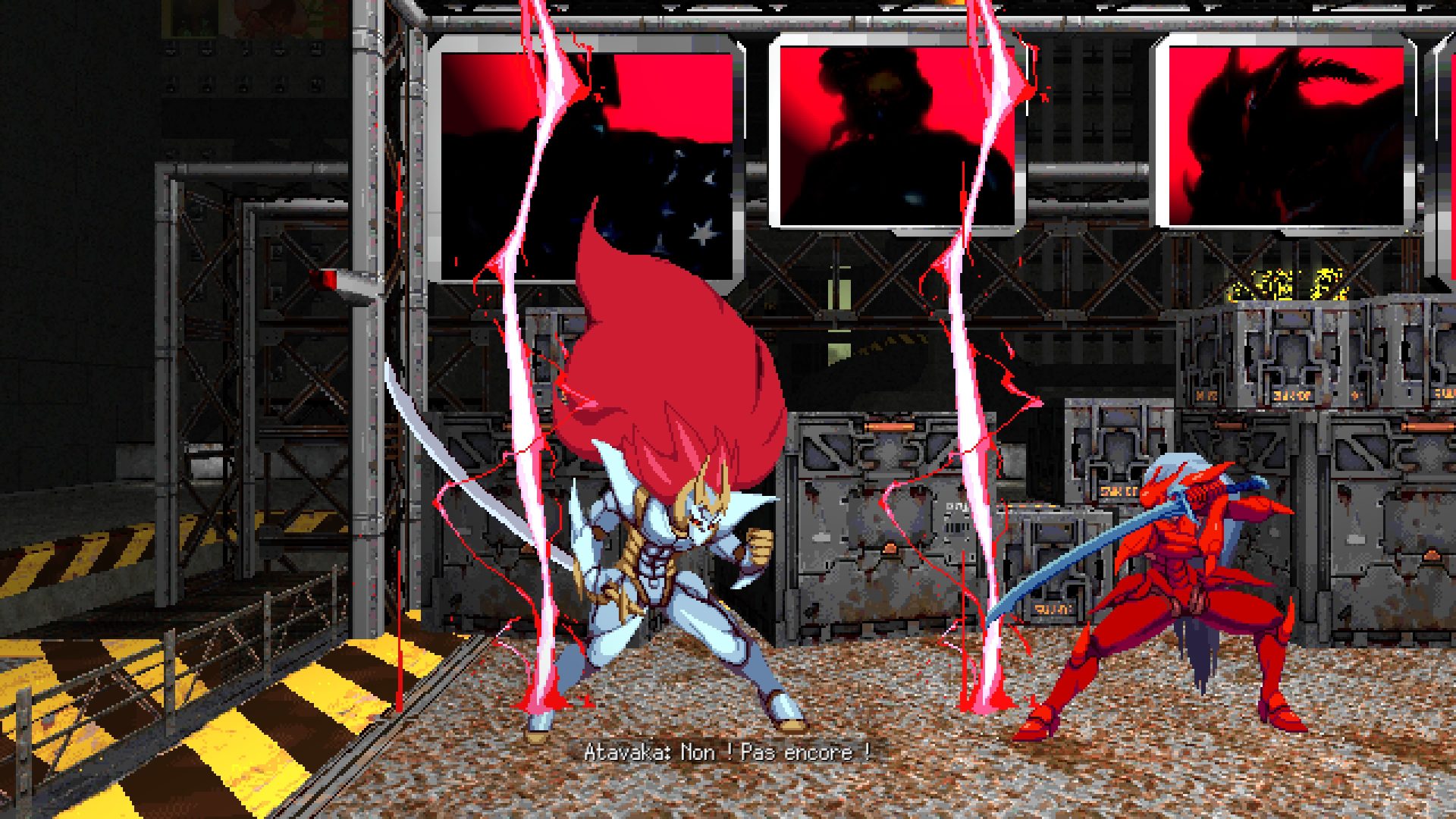
At the top, in what is called the Palace, closest to satisfying our vengeance, the waves of belligerents strengthen to become suffocating. The beauty of the place overwhelms us, except that the attacks do too. Slave Zero then reveals the malice and injustice that inhabits him. The inaccuracies, the unbalanced waves, the game is in no way fair. As much by choice as by obvious lack of finish (expect a few crashes on PS5). Nevertheless, despite finances that we guess are modest, the care given to the atmosphere of the title and the gameplay are enough to provide the dose of adrenaline that we hoped to find when launching the game. In addition, the difficulty is adaptive (without ever becoming easy) and will adjust according to your skills.
In addition to the significant influence of Strider 2claimed by the developers and by Francine Bridge, the legacy of Devil May Cry as much as that of Ninja Gaiden shine through — even if the latter is not explicitly mentioned. But that’s not all: fighting games have also influenced game design. Without repeating the history of the affiliation between fighting games and beat’em all, in Slave Zerothe relationship is obvious. Not surprising, knowing that the teams do not hide the borrowings from Arc System Works licenses: Guilty Gear, BlazBlue. The race of Shou, hero of Slave Zerois also reminiscent of that of Sol Badguy in the Arc System Works games, while the combos and the feeling of the controller in hand come straight out of versus fighting.
Jump attack cancellation as in DMCa resumption — in a way — of the novel cancel system of Guilty Gear to execute richer, more complex and devastating combos under certain conditions, dodge and parry: the game has the complete arsenal of a good fighting game. If we regret a small number of different moves – especially on the initial layer of gameplay – the learning curve is sufficient so that we have something to experiment with and that we don’t get bored too quickly. Although short and repetitive in its bestiary and combat situations, the Purple Citadel game mode should satisfy the most determined and talented players for a while.
Much more challenging than the base game, the mode offers a sequence of fights summoning the Bloody Palace from the Capcom license, with its own rules. The goal is to push us to surpass ourselves and discover the glass ceiling of gameplay. Playing a particular game mode puts your endurance to the test as well as your skills, even when the action becomes difficult to read. The presence of a training room will take on its full meaning with this mode which is like the Poppy Works game: without concessions. You will have to deserve the end of the adventure to unlock the Citadel, and deserve the completion of this last mode where you come across all the enemies of the game, the bosses too, in various configurations and no more loyal than the usual confrontations in Slave Zero.
Despite the game’s flaws and imperfections, and crashes that can also occur, the experience is attractive. We want to return to it, to encounter it again and again, even if it is to suffer and enrage. As if these injustices and these frustrations fuel the rage that we then vent in-game. There is something deeply cathartic in this beat’em all. Once Shou and his armor, X, are fully mastered, when the most technical sequences are executed fluidly, the game becomes almost visceral. The weight of the sword is felt in every impact, in every cut enemy, in every key press. Adversity summoned by Slave Zero is unfair and punitive, but just as exhilarating and addictive. An uncompromising software that requires players to make a real commitment. Here, we don’t unplug our brain to decompress: we decompress by straining it to the point of syncope.