Preview conditions: We were able to play half of the season of Dispatch, episodes 1 to 4. The embargo being limited to the first two episodes, we will only discuss the details of these first two (the images are also from episodes 1 & 2), without spoilers, while giving an overall opinion on this half of the season.
The man behind the machine
If you’ve consumed any superhero content in recent years, Dispatch will speak to you. Sometimes evoking Marvel, then Invincibleand more lightly The Boysthe game from Adhoc Studio clearly does not hide its influences and is in tune with the times by offering a critical vision of superheroes, with a dysfunctional society that revolves around these superhumans. The angle chosen in this universe is still interesting.
Here you play Robert Robertson, who, in addition to having a name that attracts all the mockery, is a superhero who has fallen from grace. Also known as Meca-Man, a sort of Iron Man if Tony Stark had kept his very first armor, he is forced to retire a little earlier than expected following an unlucky encounter with a supervillain.
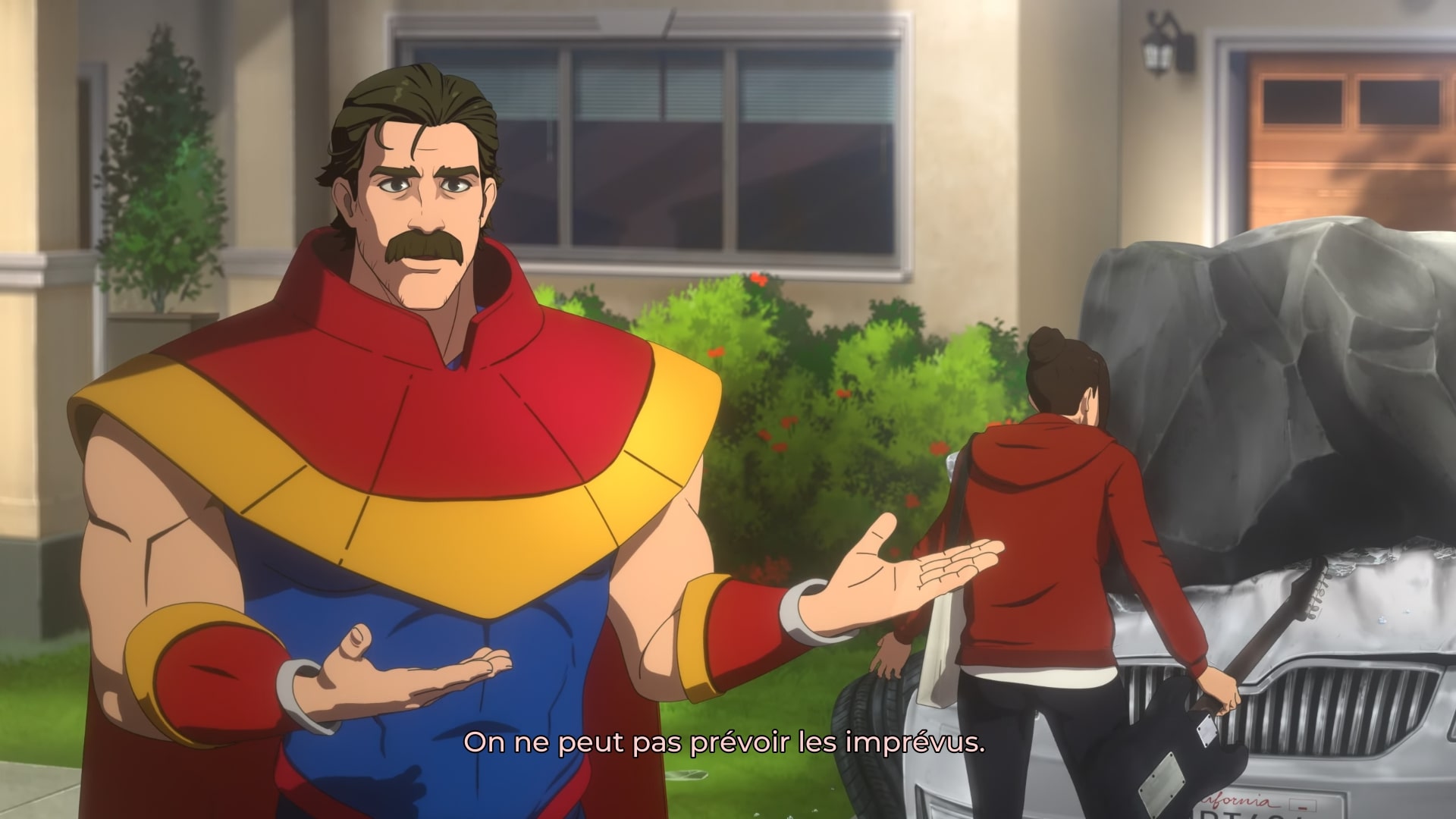
To restore his health, he is recruited by a superhero agency as a “dispatcher”, a communications agent placed at the head of a team of superheroes, whom he must manage from his office by sending them to carry out the right missions. And since bad luck pursues him, he is placed in command of Team Z, the losers among the losers, supervillains converted into superheroes in the hope of not ending up in prison. You will have to compose a batman who is far from being Batman, a demonic warrior with powers reminiscent of Magik, a very vulgar invisible thief, an overconfident pop star… A Suicide Squad emerges, without the bomb in her head and with suitable office hours.
Civil servants like the others
Because despite all this superheroic context, Dispatch wants to anchor you in office life. Between the awkward encounters in the toilets, the shouting matches in the break room, the theft of equipment, it’s all there, super-human or not. A perfect way to make these characters more down-to-earth and more human. Funnier too, which we owe to impeccable dialogue timing, as well as natural language and crude lines. Adhoc limits himself in the representation of violence, but does not hesitate to push the cursor of crudeness to the maximum, without it appearing forced.
Not everything is surprising or rich in subtexts, probably the fault of the hackneyed superheroic genre or the storytelling format which relies on choices (and is therefore less controlled than a more directive narrative). We also feel the lack of time to develop certain characters, which will perhaps be made up for in the second half of the season. But let’s not shy away from our pleasure. Dispatch offers a very entertaining experience, to the point where an hour-long episode will seem to last three times less time.
And all this results in an impeccable casting, served by top-notch voice actors. We owe this in part to the Critical Role collective, which also participated in the development of the game, given that Adhoc will develop a game on Exandria, the universe created by the group (and we can’t wait to see that). With Laura Bailey (Abby in The Last of Us Part II) or Travis Willingham (Thor in Marvel Rivals) via Matthew Mercer (Vincent in Final Fantasy VII Rebirth), these dubbing professionals rightly support this good writing. Same thing for Aaron Paul and Jeffrey Wright, and even for those who come from the world of YouTube (MoistCr1TiKaL, Jacksepticeye…) and who demonstrate here that it is not just a question of “star talent”.
An office life that is not easy
Despite this kick in the perineum mentioned earlier, Dispatch exudes the Telltale formula from every pore. Impossible to get rid of the idea that we are playing here a title which captures all the codes of the formula, with lots of choice dialogues with more or less direct consequences. Even the cutting is somewhat predictable here. As long as one has the experience of The Wolf Among Usthe structure of the story is obvious, as is the timing of crucial choices.
So what’s changing? Well, apart from the striking visual aspect of the game, its gameplay. Dispatch only gives us full control when Robert does his job. This results in a management part in which you must assign your super-losers to the right place, according to the strengths and weaknesses of each.
A simple principle, which becomes complex quite quickly. Choosing the right people is not always easy, as the game shows a bit of subtlety in relation to the tasks required. Sometimes you’ll need to send multiple agents to complement each other’s strengths, but that’s if you can. Aside from scheduling issues, some agents will occasionally refuse to participate in missions, or may jeopardize them. Because even if you are only in front of a management screen as simple as possible, the story continues and the dialogues flow during this part.
Over the course of the episodes, management intensifies with double requests, puzzles to solve, or even agents who will gain very special abilities to use wisely. Add to this a seemingly simple hacking mini-game, which also gains in complexity as the episodes progress. A few cinematic sequences add a little interactivity, but they remain very limited in number.
Dispatch is frugal here, no doubt for his own good. Everything he does, he does it well. And that’s all that is asked of him after a first half of the season which starts very well, and which proves that the genre still has something to offer when it is mastered. This is evidenced by our great impatience at the idea of discovering the next episodes. As a reminder, the first two episodes of Dispatch will be available from October 22, on PC and PS5. Two episodes are planned per week, for a season of 8 episodes, which means that the season will be complete from November 12.