In search of the card master
For beginners, some of the new products are aimed directly at them. We had the chance to test the learning box accompanied by real beginners and it was quite well constructed. Obviously it’s better with someone who already knows the game but there is no doubt that this box is easily used without knowing Magic beforehand.
It includes all the accessories for the first games (tokens, detailed board, d20 and rulebook) as well as two beginner decks. We feel the inspiration of guided video game tutorials because here these decks are delivered in a precise order with a list of actions to follow to discover the different combat phases and interactions. Once you have mastered the basics, all you have to do is mix two of the 8 Jumpstart decks to play your first real duels and discover the basic mechanics of Magic but also of this expansion.
Avatar’s element system makes understanding Magic colors quite intuitive. Be careful, however, not to confuse Magic’s color philosophy with simple elements. For example, firebenders like Azula or Ozai are in the color black and not red which represents their thirst for power much more. And most Water Tribe warriors are on white cards, favoring their sense of order and discipline over typical blue card wisdom.
But what about the quality of the expansion for other categories of players? Fans of the series and collectors will be able to find emblematic scenes and almost all of the characters from the original series. Unfortunately no Korra yet, but given the pace of release of collaborations, in particular those linked to Nickelodeon, it won’t be long.
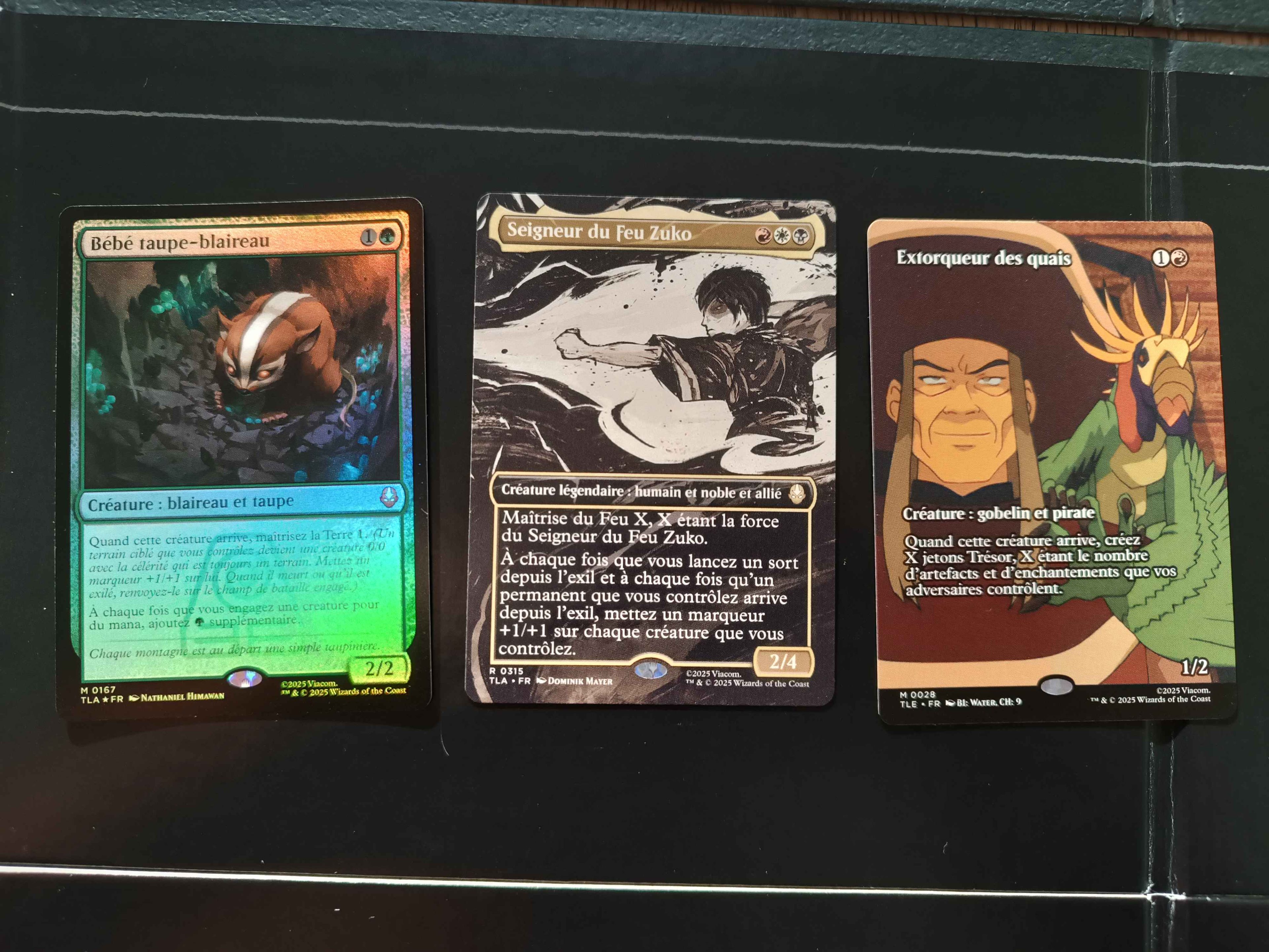
We are delighted to see the number of different artistic treatments on the cards. However, a small failure has crept into the alternative maps. Some are just screenshots of the cartoon in questionable visual quality. Too bad, a little work on them would have drastically improved their quality.
And the gameplay? And the meta?
It’s been several expansions that certain cards with too high a power level have slipped through the cracks. Is this voluntary? Impossible to be sure. Regardless, Avatar is no exception to this rule. The ban wave arrived at the beginning of November, with the departure of Vivi, a dark mage lost from the standard format, at the top of the list. The goal was obviously to give Avatar free rein to impact the meta.
Despite this, few cards currently stand out. We can still mention the baby mole badger. A mana doubler on a card with only two mana, who could have predicted its power as soon as it hits the board. Outside of the standard, in formats where tutors are more widespread, Wan Shi Tong, librarian, also makes an impact, generating a lot of resources for little money.
Special mention to the return of the lessons and the archetype that goes with them. For newcomers, the lessons introduced in the Strixhaven expansion can be accessed from the sideboard using cards with the Learn ability. In Strixhaven these were cards with rather average power but their ease of access and their versatility were their strength.
On the other hand, for Avatar, no card has the Learn ability, so in standard it is impossible to fetch lessons from the reserve. In exchange we have a rereading of the mechanics with synergies counting the number of lessons in the cemetery. This allows for more powerful lessons than back then. In older formats, more useful lessons also allow a slight return of this mechanic.
Whether you’re a beginner, experienced, or just a fan of Avatar the Last Airbender, this expansion has something for everyone. However, let’s see the evolution of the meta in standard: can the format which has seen a fairly significant drop in players recently maintain a solid player base? We also regret the increase in prices of all products, directly linked to the additional cost of using external licenses.