Preview conditions: We were able to play 3 hours of My Hero Academia All’s Justice via its Steam version. We were able to try various game modes while having access to the full roster of characters.
From origins to flight
Just like the Bones studio let loose on the last season of the anime My Hero AcademiaByking seems to have had a little more budget and time for this My Hero Academia All’s Justiceall measures kept for an adaptation like this. However, the basics do not change that much. The formula My Hero One’s Justice is always present, that is to say very close to that of a Naruto Ultimate Ninja Storm with an arena-fighter with rather floating controls and very simple combos to chain together, especially with the integration of a mode which allows the general public to trigger series of attacks via a single button.
No question of going to unknown lands here, but the combat system appears more complete than in the pasteven if it gets rid of one element, that of “Ultimate attacks” (whether in duo or team), which are no longer entitled to a nice staging. Which is still very regrettable for the spectacular aspect of the clashes. To replace that, this episode focuses everything on the Rising mechanic, which is the equivalent of the Awakening system in other games of the genre. The more the fight progresses, the more your characters will progress this gauge and will then be able to unleash themselves with more powerful attacks and a moveset that will adapt to their “transformation”. Nothing revolutionary here except that it’s a little more exhilarating to discover all the changes it brings to each character.
The mechanics of the “Plus Ultra” attacks are limited to special attacks (a little poorer visually) to be used well during a combo or to surprise an opponent, and if it is divided into 3 bars, it is mainly because this time the game offers real 3 vs 3 combat. In the past, it was possible to choose two sidekicks to come and give us a helping hand from time to time, while My Hero Academia All’s Justice has us play as three characters, each with their own health bar.
Triggering a Plus Ultra attack when the 3 bars are filled then allows you to chain together the attacks of the three members of our team. And when there is only one active character left in our ranks, he enters the ring with his Rising transformation directly activated, to allow us to try to turn the tide. Add to that guard crush, dodge and interrupt mechanics which work a bit like rock-paper-scissors and which add a little depth to the whole thing.
It’s effective, easy to useand the multitude of characters makes us think that there will be enough to find subtleties for a little while, provided that the balancing is there. Which is not a given, because an All For One is still much more likely to be annoying than an Ojiro. We will still give special mention to certain newcomers in the cast despite obvious absences (where is Spinner?), like this very well thought-out Armored All Might or this new version of Izuku who is very pleasant to handle thanks to his use of the Black Whip.
It remains that the movements of our characters are still soapy and that the dashes are neither precise enough nor fast enough to be satisfactory, making everything sometimes confusing, especially when a deluge falls on the screen. This is the problem of many arena-fighters you will tell us, but My Hero Academia All’s Justice suffers from it more than others.
A hero’s life that is not very captivating

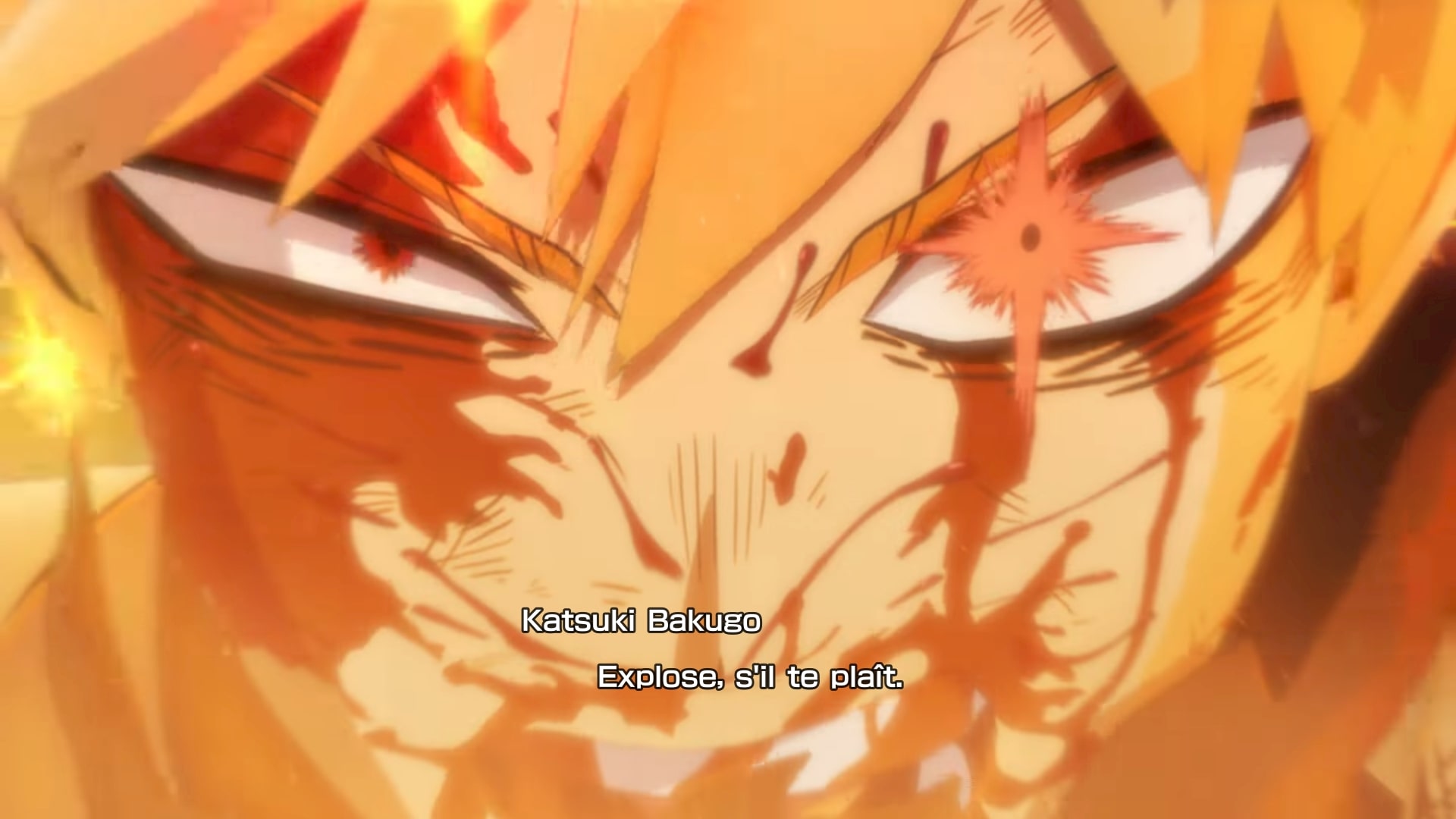
The efforts made on the combat system are not the only ones undertaken by Byking, who decided to multiply the game modes to ensure fan service on this (probable) last game My Hero Academia. The Story mode, for example, retraces the final arc of the manga by alternating between “slideshow” scenes (but a little better constructed than in other similar games) and much better animated sequences, even if the latter obviously remain short and are only shortened scenes of what really happens in the anime or manga.
The studio has also chosen to articulate all the different game modes around an open world, or rather of a small open area as its size is small, which is in reality just there to serve as a central HUB and give a little more freedom during missions. You can walk around there to complete a few missions and have access to the different menus, while enjoying the traversal mechanics of certain characters, mainly those of the second class A.
Deku can, for example, play the poor man’s Spider-Man with his Black Whip to swing from building to building; Ochako can float to the top of a building; Tokayami uses Dark Shadow to fly… Not all members of the class are in the same boat here depending on their Quirk, but that’s not a big deal since wandering around the city ultimately has little point in any case, as we’re faced with minimal service.
The game, however, attempts to vary the missions by offering activities other than combat, such as races or research phases where certain high school students will be more advantaged than others. A stroke of the sword in the water, so much these sequences turn out to be academic and limitedat least for the little time we were able to devote to it. Hopefully other missions will raise the level.
This mode even takes its name from the spin-off Team-Up Missionwhich offers to see Deku and his comrades in situations other than those of the main manga, but the stories told here are still much less interesting than those of Yōkō Akiyama’s manga. Same thing for another mode in which the students share a few moments of complicity, with small personal episodes with a very light tone which again bring a bit of very nice fan service.
This overview will at least have shown us that there is a desire to do well at Byking. So of course, not everything works and it is easy to discern what appears to be filler and what is more of a good fan service. Still, the formula My Hero One’s Justice here is a little more mature and this new essay makes us easily say that this episode has everything to be the best of the three, which was far from being an insurmountable challenge, you will tell us. Failing to push the limits, My Hero Academia All’s Justice could satisfy those who are barely recovering from the end of the manga and anime.